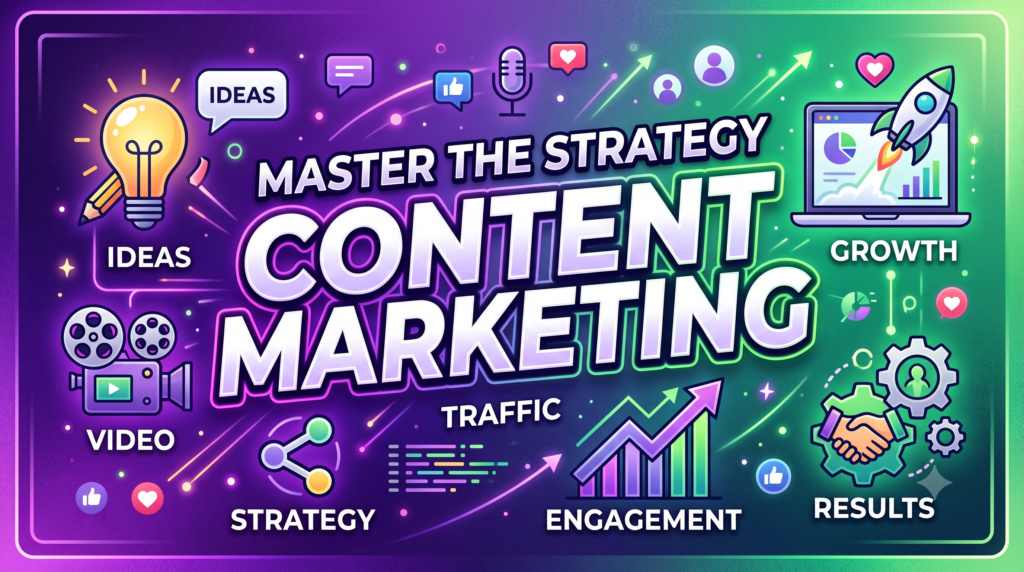
Content Marketing Strategy is the foundation of a strong digital presence because it connects useful information with the people who need it. A good plan helps a website attract visitors, answer questions, build trust, and support business goals without depending only on paid advertising. For beginners, the biggest challenge is often not creating content but knowing what to create, who it is for, where to publish it, and how to measure results.
In this guide, we will explain how to build an effective Content Marketing Strategy from the ground up. You will learn how to research your audience, choose topics and keywords, create useful content, distribute it across channels, optimize it for search engines, and improve performance over time. The goal is not to publish as much as possible. The goal is to publish content that is relevant, useful, consistent, and connected to a clear objective.
What Is Content Marketing Strategy?
A Content Marketing Strategy is a documented approach for planning, creating, distributing, and measuring content that supports a specific marketing objective. It answers practical questions such as: Who are we trying to reach? What problems do they have? What information can we provide? Which formats should we use? Where should the content be published? How will we know whether it is working?
Unlike random posting, a Content Marketing Strategy gives every major piece of content a purpose. A blog post might attract people searching for an answer. A guide can educate visitors who are comparing solutions. A case study can build trust with people close to making a decision. A social post can introduce a topic and bring new users to a website.
The strategy should also connect content with the customer journey. Someone who has never heard of a brand needs different information from someone who is ready to buy. Mapping content to awareness, consideration, and decision stages makes the overall plan more useful.
Why a Content Marketing Strategy Matters
A Content Marketing Strategy can help a brand create long-term visibility. Search-friendly articles may continue attracting visitors after publication, while helpful social content can encourage people to follow, share, save, or visit a website.
Another advantage is consistency. When a business has a clear editorial plan, it becomes easier to maintain a regular publishing schedule. Consistency does not mean publishing every day. It means setting a realistic standard that can be maintained.
A strong Content Marketing Strategy also reduces wasted effort. Without a plan, marketers may spend hours creating posts that have no clear audience, keyword target, call to action, or measurement method. A strategy helps prioritize ideas based on business value and audience demand.
Set Clear Goals for Your Content Marketing Strategy
Before creating content, decide what success means. Goals should be specific enough to measure. Common objectives include increasing organic traffic, generating leads, improving brand awareness, building an email list, increasing engagement, supporting sales, or improving customer retention.
For example, a beginner website might choose a goal of increasing organic search traffic over six months. Another business might focus on collecting qualified email subscribers. A service provider could measure consultation requests generated from educational articles.
Your Content Marketing Strategy should connect each goal with relevant metrics. Traffic can be measured through sessions and users. Lead generation can be measured through form submissions. Engagement can include comments, shares, saves, or average engagement rate. Conversion-focused content can be evaluated by clicks, sign-ups, purchases, or inquiries.
Avoid choosing too many goals at once. A focused plan is easier to execute and improve. Once the basic system works, additional objectives can be introduced.
Define Your Target Audience
Audience research is one of the most important parts of a Content Marketing Strategy. You need to understand the people you want to help before deciding what to publish.
Start with basic questions. What is your audience trying to achieve? What problems make the process difficult? What questions do they type into search engines? Which platforms do they use? What language do they understand easily? What prevents them from taking action?
You can use customer conversations, website analytics, search suggestions, community discussions, reviews, surveys, and competitor content to discover recurring questions. Look for patterns rather than isolated comments.
Creating one or more simple audience profiles can make content planning easier. A profile can include the person’s goal, common problem, knowledge level, preferred content format, and likely objection. Keep the profile practical rather than filling it with unnecessary personal details.
Content Marketing Strategy: Build Topic Clusters
A topic cluster organizes related content around a central subject. This approach can make a website easier for users and search engines to understand.
For example, if the main topic is digital marketing, supporting articles could cover SEO, email marketing, social media marketing, content creation, analytics, and paid advertising. A pillar page can introduce the broad subject, while supporting pages answer narrower questions.
A Content Marketing Strategy based on topic clusters can also make internal linking easier. When related articles link naturally to one another, readers can move from a basic explanation to a deeper guide without leaving the site.
Start with a few important topics instead of trying to cover everything. Choose subjects that match your audience’s needs and your website’s purpose. Then expand into supporting questions and long-tail topics.
Perform Keyword Research
Keyword research helps you understand what people search for. The purpose is not to insert keywords repeatedly. The purpose is to understand search intent and create a page that genuinely satisfies it.
Start with broad topics and expand them into specific questions. Useful keyword categories can include informational searches, comparison searches, problem-based searches, product-related searches, and location-based searches when relevant.
For each keyword, consider search intent. Someone searching “what is email marketing” probably wants an explanation. Someone searching “best email marketing software” may be comparing options. Someone searching for a specific product or service may be much closer to taking action.
A useful Content Marketing Strategy balances high-interest topics with realistic opportunities. Highly competitive keywords may require stronger authority and more time. Specific long-tail queries can sometimes provide better opportunities for newer websites because the intent is clearer.
Do not create separate pages for every tiny variation of the same query. Instead, combine closely related questions when one comprehensive page can satisfy them.
Create High-Quality Content
Quality is the center of a successful Content Marketing Strategy. High-quality content should be accurate, useful, readable, original, and created for people rather than only for search engines.
Start with a strong introduction that clearly explains what the reader will learn. Organize the article with descriptive headings. Use short paragraphs, examples, lists, tables, and practical steps when they improve understanding.
Avoid unnecessary filler. A longer article is not automatically better. A 1,500-word guide that answers the reader’s questions clearly can be more valuable than a 3,000-word article filled with repetition.
Add original value wherever possible. This can include examples, screenshots, checklists, templates, personal observations, comparisons, calculations, or a unique explanation of a difficult concept.
Before publishing, check facts, links, spelling, grammar, formatting, and whether the promised answer is actually delivered.
Use Different Content Formats
A strong Content Marketing Strategy should not depend on only one format. Different people prefer different ways of learning.
Blog posts are useful for detailed explanations and search traffic. Short-form social posts can increase awareness and engagement. Videos can demonstrate processes. Infographics can simplify information. Email newsletters can build a direct relationship with subscribers. Downloadable checklists and guides can support lead generation.
Choose formats according to the topic and audience. A tutorial may work well as a video and a detailed article. A list of quick tips may work well as a carousel or short social post. A complex research finding may be easier to understand through a visual summary.
You do not need to create every format immediately. Start with one or two formats you can produce consistently, then repurpose successful content.
Create a Content Calendar
A content calendar turns ideas into an organized publishing schedule. It can include the topic, target keyword, content format, audience stage, author, deadline, publication date, promotion channel, and status.
Your Content Marketing Strategy becomes easier to manage when everyone knows what needs to be created and when it should be published.
A beginner can start with a simple weekly calendar. For example, publish one detailed blog article, create several short social posts from that article, and send a short email summary to subscribers. This approach turns one strong piece of content into several useful assets.
Avoid creating a schedule that is impossible to maintain. Sustainable consistency is more valuable than an ambitious calendar that becomes difficult after a few weeks.
Optimize Content for SEO
Search engine optimization helps relevant users discover your content. On-page SEO includes using a clear title, logical headings, a useful meta description, descriptive URLs, internal links, image alt text where appropriate, and naturally placed keywords.
In a Content Marketing Strategy, SEO should support the reader rather than control the writing. Your primary keyword should appear naturally in important locations, but you should avoid awkward repetition.
Search intent is especially important. If users want a step-by-step tutorial, a page that only gives a definition may not satisfy them. If they want a comparison, a generic overview may not be enough.
Also consider technical basics such as mobile usability, page speed, indexability, broken links, and a logical site structure. SEO is a long-term process, so monitor results and improve pages based on evidence.
Develop a Distribution Plan
Publishing content is only half the job. Distribution helps the right audience discover it.
A Content Marketing Strategy should identify the channels most relevant to your audience. These might include organic search, Instagram, LinkedIn, YouTube, email, online communities, or other platforms.
Adapt the message to each channel rather than copying the entire article everywhere. A blog article can become a LinkedIn lesson, a short video script, a carousel, an email tip, or a discussion prompt.
Owned channels such as your website and email list are especially valuable because you have more control over the audience relationship. Social platforms can help with discovery and engagement, while search can bring ongoing traffic.
Use Content Repurposing
Content repurposing allows one strong idea to become multiple assets. This saves time and helps reinforce the same topic across different channels.
For example, a long article can become five short social posts, one short video, a checklist, an email newsletter, and a visual summary. The information should be adapted rather than copied mechanically.
Repurposing works best when the original content is genuinely useful. Weak content does not become strong simply because it appears in more formats.
Your Content Marketing Strategy can include a repurposing workflow so that every major article has a promotion and reuse plan before it is published.
Build Internal Links
Internal linking connects pages within your website. Good internal links help readers discover related information and can support website structure.
When writing an article, identify pages that naturally expand on a concept. For example, a beginner guide to SEO could link to separate pages about keyword research, on-page SEO, technical SEO, and Google Search Console.
Use descriptive anchor text that tells readers what they will find. Avoid adding links simply to increase the number of links on a page.
A clear internal linking structure also helps you build topic authority over time. Related pages can work together instead of operating as isolated articles.
Add Strong Calls to Action
A call to action tells the reader what to do next. It should match the purpose of the page and the reader’s stage in the journey.
A beginner article might encourage readers to read a related guide or join an email newsletter. A comparison page might encourage users to explore product details. A service page might invite a consultation or inquiry.
The CTA should be clear and relevant. Avoid adding an aggressive sales message to every educational page. Trust grows when the next step feels helpful rather than forced.
A well-designed Content Marketing Strategy uses different calls to action for different content types. This makes the user journey more natural.
Content Marketing Strategy: Measure Content Performance
Measurement turns publishing into an improvement process. Without analytics, it is difficult to know which topics deserve more attention.
Useful metrics include organic clicks, impressions, rankings, sessions, engagement, returning visitors, email sign-ups, leads, conversions, and revenue when applicable.
Do not judge every article by the same metric. A top-of-funnel educational article may be valuable because it attracts new visitors. A product comparison page may have fewer visitors but generate more conversions.
Look for patterns. Which topics attract visitors? Which pages keep people engaged? Which articles generate internal clicks? Which content produces leads? Which pages receive impressions but few clicks?
Use these findings to update your editorial plan.
Update and Refresh Old Content
Content can become outdated. Statistics change, tools update, platforms introduce new features, and best practices evolve.
A Content Marketing Strategy should include regular content audits. Review older articles and identify pages that need updated information, improved examples, better internal links, clearer formatting, or stronger introductions.
Do not change content simply to make it look fresh. Make meaningful improvements that increase usefulness and accuracy.
Refreshing existing pages can also be more efficient than creating new articles on similar topics. Before publishing a new page, check whether an existing article could be expanded.
Avoid Common Content Marketing Mistakes
Many content problems come from strategy rather than writing ability.
One common mistake is creating content without a clear audience. Another is targeting keywords without understanding intent. Some websites publish too frequently and sacrifice quality. Others create excellent articles but never promote them.
Another problem is excessive keyword repetition. Search engines are designed to understand language and topics, so unnatural keyword stuffing can make content difficult to read.
A Content Marketing Strategy should also avoid copying competitors. Competitor research is useful for understanding gaps, but your content should provide original value.
Finally, avoid expecting instant results. Content marketing often requires consistent publishing, optimization, distribution, and measurement before strong results appear.
Use AI Carefully in Content Marketing
AI tools can help with brainstorming, outlining, research organization, rewriting, content repurposing, and idea generation. However, AI should support human judgment rather than replace it.
A good Content Marketing Strategy uses AI to speed up repetitive tasks while keeping accuracy, originality, expertise, and editorial responsibility under human control.
Always review AI-assisted content for factual errors, unsupported claims, repetitive wording, and generic advice. Add your own examples and insights where possible.
The strongest workflow is often human-led: define the audience and objective, research the topic, use AI for selected support tasks, edit carefully, add original value, and then measure performance.
Content Promotion Strategy
Promotion should begin before or immediately after publication. Share new content through relevant social channels, email newsletters, communities where sharing is genuinely useful, and internal website links.
Create several promotional messages for the same article. One can focus on a surprising insight, another on a practical tip, and another on the problem the article solves.
A Content Marketing Strategy should also account for evergreen promotion. If an article remains useful for months or years, periodically reshare it when relevant and update it when necessary.
Promotion should never become spam. Share where the content provides genuine value.
Build Trust and Authority
Trust is essential when people are deciding whether to follow advice, subscribe, contact a business, or buy a product.
Show evidence where possible. Use reliable sources, explain methods, provide examples, identify expertise, and correct errors when they are discovered.
Your Content Marketing Strategy should make credibility part of the content process. A page should communicate not only an answer but also why the reader should trust the information.
For websites in areas that affect important decisions, accuracy and responsible communication are particularly important. Avoid exaggerated promises and unsupported claims.
Create a Simple Content Funnel
A content funnel connects different pieces of content based on user intent.
At the awareness stage, educational articles and introductory videos can answer basic questions. At the consideration stage, comparison guides, tutorials, and case studies can help users evaluate options. At the decision stage, product pages, demonstrations, testimonials, and service information can support action.
A Content Marketing Strategy becomes more powerful when these stages are connected. Instead of treating every article as a separate project, create pathways that help users move from learning to deeper research and, when appropriate, conversion.
Internal links and relevant CTAs can guide that journey.
Make Your Strategy Sustainable
Sustainability matters because content marketing is a long-term activity. Build a workflow that matches your time, skills, budget, and resources.
Start small. Choose a manageable publishing frequency, a clear audience, a focused set of topics, and a few distribution channels.
A practical Content Marketing Strategy can begin with one high-quality article each week and a simple repurposing process. As the system becomes easier, increase output carefully.
Create reusable templates for briefs, outlines, SEO checks, social promotion, and content audits. Templates reduce decision fatigue and make quality more consistent.
Example of a Beginner Content Marketing Strategy
Imagine a beginner digital marketing website wants to attract students and new professionals.
The first goal could be organic traffic and email subscribers. The audience needs simple explanations, tutorials, and practical examples.
The site could create a pillar article about digital marketing, followed by supporting articles about SEO, email marketing, social media marketing, content creation, analytics, and AI tools.
Each article would target a distinct search intent. Internal links would connect related pages. Social posts would summarize useful lessons, while an email newsletter would share new articles and practical tips.
The Content Marketing Strategy would be reviewed every month. High-performing topics would receive updates and additional supporting content. Pages with impressions but low click-through rates would receive better titles and meta descriptions. Pages with strong traffic but weak conversions would receive improved relevant CTAs.
This example shows that a strategy does not have to be complicated. It needs clear goals, audience understanding, useful content, distribution, and measurement.
10-Step Content Marketing Strategy Checklist
Use this checklist before publishing a major piece of content:
- Define the business or website goal.
- Identify the target audience.
- Choose a topic based on audience needs.
- Research keywords and search intent.
- Review competing pages and identify gaps.
- Create a useful outline.
- Write original, clear, accurate content.
- Optimize the page for SEO and readability.
- Promote and repurpose the content.
- Measure results and update the strategy.
This checklist can become part of your regular workflow. The more consistently you use it, the easier content production becomes.
Content Marketing Strategy: Final Thoughts
A successful Content Marketing Strategy is not about publishing the largest number of articles. It is about creating the right information for the right audience at the right stage of their journey.
Start with a clear goal. Understand your audience. Research topics and search intent. Create useful content that answers real questions. Optimize it for search without sacrificing readability. Distribute it through channels your audience actually uses. Measure performance, improve what works, and update older content when necessary.
For beginners, the most important lesson is consistency. You do not need a huge team or a massive budget to start. A focused website, a realistic publishing schedule, useful content, and regular measurement can create a strong foundation.
The best Content Marketing Strategy evolves with your audience and your data. Keep learning from what people search for, what they read, what they click, and what they find useful. Over time, this process can turn individual articles into a connected content system that supports visibility, trust, engagement, leads, and sustainable growth.