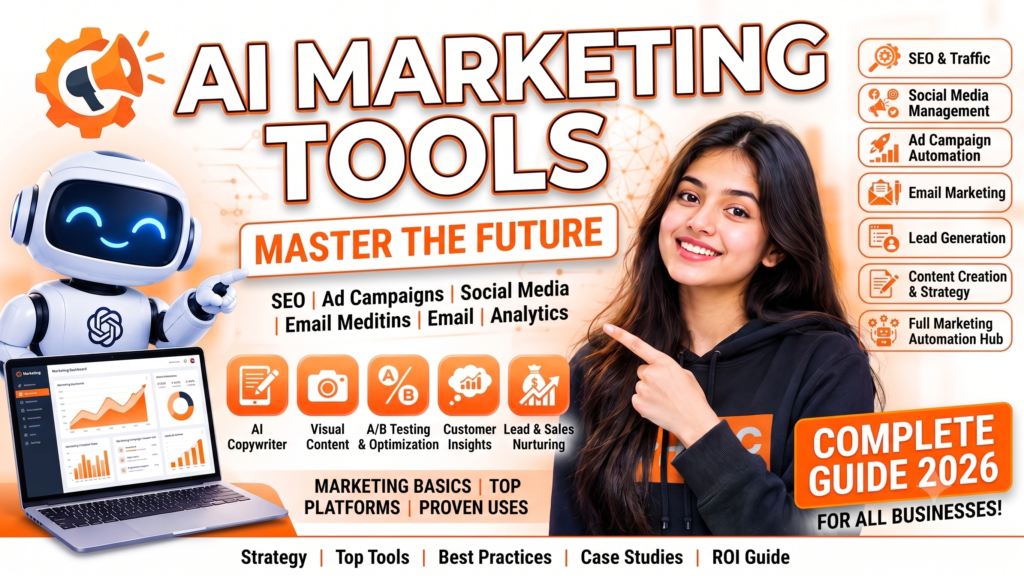
15 Powerful AI Tools for Marketing: Avoid These Costly Mistakes in 2026
AI tools for marketing are changing the way businesses, freelancers, creators, agencies, and beginners plan and execute digital marketing campaigns. From generating content and researching keywords to creating social media posts, analyzing customer behavior, improving SEO, and optimizing advertising campaigns, artificial intelligence can help marketers save time and work more efficiently.
However, using AI does not automatically guarantee successful marketing. Poor prompts, inaccurate information, low-quality content, over-automation, and ignoring the human side of marketing can create serious problems.
That is why understanding both the advantages and limitations of AI tools for marketing is important for anyone who wants to build effective digital marketing strategies in 2026.
In this complete beginner-friendly guide, you will learn what AI marketing tools are, how they work, the most useful categories of AI tools, 15 important ways marketers can use them, common mistakes to avoid, and how beginners can build an effective AI-powered marketing workflow.
What Are AI Tools for Marketing?
AI tools for marketing are software applications that use artificial intelligence technologies to help marketers perform different marketing activities more efficiently.
These tools can analyze information, identify patterns, generate content, automate repetitive tasks, summarize data, suggest ideas, assist with customer communication, and support decision-making.
Traditional marketing often requires marketers to manually perform many repetitive tasks. AI can assist with some of these activities and allow marketers to spend more time on strategy, creativity, research, and customer relationships.
For example, an AI marketing tool can help you:
- Generate blog topic ideas
- Create content outlines
- Research keywords
- Improve SEO content
- Write social media captions
- Generate email ideas
- Analyze marketing data
- Create advertising copy
- Brainstorm video concepts
- Summarize customer feedback
- Automate repetitive marketing tasks
- Personalize customer communication
AI should be treated as a marketing assistant, rather than a complete replacement for human judgment.
Why AI Tools for Marketing Are Important in 2026
Digital marketing is becoming increasingly competitive. Businesses are publishing content across websites, search engines, social media platforms, email channels, video platforms, and online advertising networks.
Marketers therefore need to work efficiently while maintaining quality.
AI can help marketers manage large amounts of information and complete certain repetitive tasks faster.
For beginners, this can be especially useful because AI can provide explanations, examples, brainstorming support, and content structures.
For experienced marketers, AI can support research, analysis, personalization, and workflow automation.
The important point is that AI works best when it is combined with:
- Human creativity
- Marketing knowledge
- Customer research
- Brand strategy
- Fact-checking
- Original ideas
- Performance analysis
The goal should not be to produce the maximum amount of content. The goal should be to create useful content for the right audience.
15 Powerful Ways to Use AI Tools for Marketing
1. AI Tools for Marketing Content Creation
One of the most common applications of AI tools for marketing is content creation.
Marketers can use AI to brainstorm topics, create outlines, develop drafts, rewrite sentences, generate FAQs, and create content variations.
For example, if you run a beginner digital marketing website, AI can help you brainstorm topics such as:
- Digital marketing for beginners
- SEO basics
- Social media marketing
- Email marketing
- Google Search Console
- Keyword research
- Content marketing
- AI marketing tools
- Online communication
- Freelancing skills
However, AI-generated content should not simply be copied and published without review.
A good workflow is:
Research → AI assistance → Human editing → Fact-checking → SEO optimization → Publishing
This process can help maintain quality while saving time.
2. AI Tools for Marketing Keyword Research
Keyword research is an important part of SEO.
AI can help marketers brainstorm search queries related to a topic and organize them according to search intent.
For example, for the topic AI tools for marketing, possible keyword variations include:
- best AI tools for marketing
- AI tools for digital marketing
- AI marketing tools for beginners
- AI tools for SEO
- AI tools for content marketing
- AI tools for social media
- AI tools for email marketing
- AI marketing software
- free AI marketing tools
AI can also help categorize keywords into different search intents:
Informational:
“What are AI tools for marketing?”
Commercial:
“Best AI tools for marketing”
Transactional:
“AI marketing software pricing”
Navigational:
“AI marketing tool login”
However, marketers should verify keyword demand and competition using dedicated SEO and keyword research platforms instead of assuming that AI-generated keyword ideas have high search volume.
3. AI Tools for Marketing SEO
SEO is another area where AI can support marketers.
AI can help with:
- Content outlines
- Keyword variations
- Search intent analysis
- Title ideas
- Meta descriptions
- FAQ ideas
- Internal linking suggestions
- Content optimization
- Content gap brainstorming
- SEO checklists
For example, if your focus keyword is AI tools for marketing, AI can suggest related topics and help organize a long-form article.
A simple SEO workflow could be:
Keyword → Search intent → Outline → Content → Optimization → Internal links → Search performance analysis
Remember that SEO is not simply about inserting a keyword repeatedly.
Modern SEO should focus on creating helpful, relevant, readable, trustworthy content that satisfies the user’s search intent.
4. AI Tools for Marketing Social Media
Social media marketers often need to create content consistently.
AI can assist with:
- Instagram caption ideas
- LinkedIn post ideas
- Facebook content
- Short-form video concepts
- Reel hooks
- Content calendars
- Hashtag brainstorming
- Audience questions
- Call-to-action ideas
For example, a digital marketing beginner could ask AI to create 30 content ideas around SEO.
The ideas can then be reviewed and converted into original posts.
A useful social media workflow is:
Audience research → Content idea → AI brainstorming → Human creativity → Visual → Publishing → Analytics
AI can make the planning process easier, but marketers should still understand their audience and platform-specific communication styles.
5. AI Tools for Marketing Email Campaigns
Email marketing requires planning, segmentation, writing, testing, and analysis.
AI can help marketers develop:
- Subject line ideas
- Email introductions
- Promotional copy
- Newsletter topics
- Welcome email concepts
- Follow-up email ideas
- Customer segmentation ideas
- A/B testing variations
For example, instead of manually brainstorming 20 subject lines, a marketer can use AI to create multiple options and then select and edit the most suitable ones.
However, marketers should avoid sending large quantities of generic AI-generated emails.
Personalization should be based on meaningful customer information and legitimate marketing practices.
6. AI Tools for Marketing Advertising
Paid advertising involves creating multiple versions of headlines, descriptions, calls to action, and creative concepts.
AI can help marketers brainstorm different ad variations.
For example:
Product: Online marketing course
Possible messaging angles could include:
- Learn digital marketing step by step
- Build practical marketing skills
- Start your digital marketing journey
- Learn SEO and social media basics
AI can help generate variations, but the marketer should check every claim before using it in an advertisement.
Advertising platforms also have their own rules and policies, so AI-generated copy should always be reviewed before publishing.
7. AI Tools for Marketing Customer Research
Understanding customers is one of the most important parts of marketing.
AI can help organize and summarize customer feedback from legitimate data sources.
For example, marketers can categorize feedback into:
- Product problems
- Price concerns
- Delivery issues
- Customer service complaints
- Feature requests
- Buying motivations
- Frequently asked questions
This can help businesses identify recurring themes.
However, AI analysis should not replace direct customer research.
Customer interviews, surveys, reviews, support conversations, and real behavioral data remain valuable sources of insight.
8. AI Tools for Marketing Personalization
Customers often respond better to communication that is relevant to their interests.
AI can support personalization by helping marketers organize audiences into groups.
For example:
New visitors
→ Educational content
Returning visitors
→ Product comparisons
Existing customers
→ Product education or relevant offers
Inactive customers
→ Re-engagement campaigns
This type of segmentation can make marketing communication more relevant.
But personalization should be transparent and responsible. Businesses should follow applicable privacy laws and platform policies when using customer information.
9. AI Tools for Marketing Analytics
Marketing produces large amounts of data.
AI can help marketers understand patterns in data and turn complicated information into easier-to-understand summaries.
Important marketing metrics may include:
- Website traffic
- Click-through rate
- Conversion rate
- Engagement rate
- Email open rate
- Cost per click
- Return on advertising spend
- Leads
- Sales
- Customer acquisition cost
For example, an AI assistant can help explain what a particular metric means or help organize a marketing report.
However, AI should not be trusted blindly with business decisions.
Always verify important conclusions against the original analytics data.
10. AI Tools for Marketing Competitor Research
Competitor research helps marketers understand the market.
AI can help organize publicly available information about:
- Competitor products
- Content topics
- Marketing channels
- Customer reviews
- Positioning
- Pricing information
- Social media content
- Website structure
For example, a marketer can create a comparison table showing how several brands position similar products.
The purpose should be to understand the market and identify opportunities for differentiation.
Competitor research should rely on legitimate, publicly available information rather than unauthorized access to private data.
11. AI Tools for Marketing Video Content
Video marketing is an important part of digital communication.
AI can support video planning by helping marketers generate:
- Video topics
- Hooks
- Scripts
- Scene ideas
- Captions
- Titles
- Descriptions
- Content repurposing ideas
For example, a 1,000-word blog article can be converted into ideas for:
- One YouTube video
- Five short videos
- One LinkedIn post
- One Instagram carousel
- Several social media captions
This is called content repurposing.
The original content still needs human review to ensure accuracy, personality, and originality.
12. AI Tools for Marketing Design Ideas
Some AI-powered tools can help marketers generate visual concepts and creative directions.
They can assist with:
- Thumbnail ideas
- Social media layouts
- Ad concepts
- Brand moodboards
- Presentation ideas
- Image prompts
- Creative variations
For beginners, this can reduce the difficulty of starting a design project.
However, visual consistency is important for branding.
A business should maintain consistent:
- Typography
- Logo usage
- Brand colors
- Tone
- Imagery
- Layout style
AI-generated designs should therefore be adapted to the brand rather than used without customization.
13. AI Tools for Marketing Automation
Marketing automation can reduce repetitive work.
Depending on the platform, automation can support activities such as:
- Email workflows
- Lead management
- Customer segmentation
- Reporting
- Content scheduling
- Notifications
- Data organization
AI can add intelligence to some workflows by helping classify information or generate responses.
But automation needs monitoring.
A completely automated marketing system can create problems if incorrect information is published or sent to customers.
A good principle is:
Automate repetitive tasks, but keep humans involved in important decisions.
14. AI Tools for Marketing Customer Support
AI-powered chatbots and assistants can help businesses answer common customer questions.
For example, an online store may provide automated information about:
- Product availability
- Delivery information
- Store policies
- Frequently asked questions
- Basic product information
This can improve response speed.
However, customers should have a clear way to reach human support when a problem requires human judgment.
AI customer support works best when it handles simple questions while complex situations are transferred to trained employees.
15. AI Tools for Marketing Productivity
Perhaps the biggest benefit of AI is not one specific marketing task but overall productivity.
A marketer can use AI as a brainstorming and organization assistant for:
- Campaign planning
- Meeting summaries
- Research organization
- Content calendars
- Marketing checklists
- Reports
- Ideas
- Drafting
- Repurposing content
This can help beginners organize their workflow and allow experienced marketers to focus more on strategy.
Best Categories of AI Tools for Marketing
There is no single AI tool that is perfect for every marketing activity.
Instead, marketers can choose tools according to their specific requirements.
| Marketing Activity | AI Tool Category |
|---|---|
| Content writing | AI writing assistants |
| SEO | AI SEO tools |
| Keyword research | Keyword research platforms |
| Social media | AI social media tools |
| Email marketing | AI email platforms |
| Advertising | AI ad optimization tools |
| Analytics | AI analytics tools |
| Design | AI design tools |
| Video | AI video tools |
| Customer support | AI chatbot tools |
| Automation | AI workflow tools |
| Research | AI research assistants |
The best choice depends on your goals, budget, skills, marketing channel, and business requirements.
Free vs Paid AI Tools for Marketing
Beginners often want to know whether they should use free or paid AI tools.
Free AI Tools
Free tools can be useful when you are:
- Learning AI
- Testing ideas
- Starting a blog
- Practi
Pingback: 10 Powerful New AI Tools That Will Supercharge Your Productivity (Sentiment: Powerful, Supercharge)