
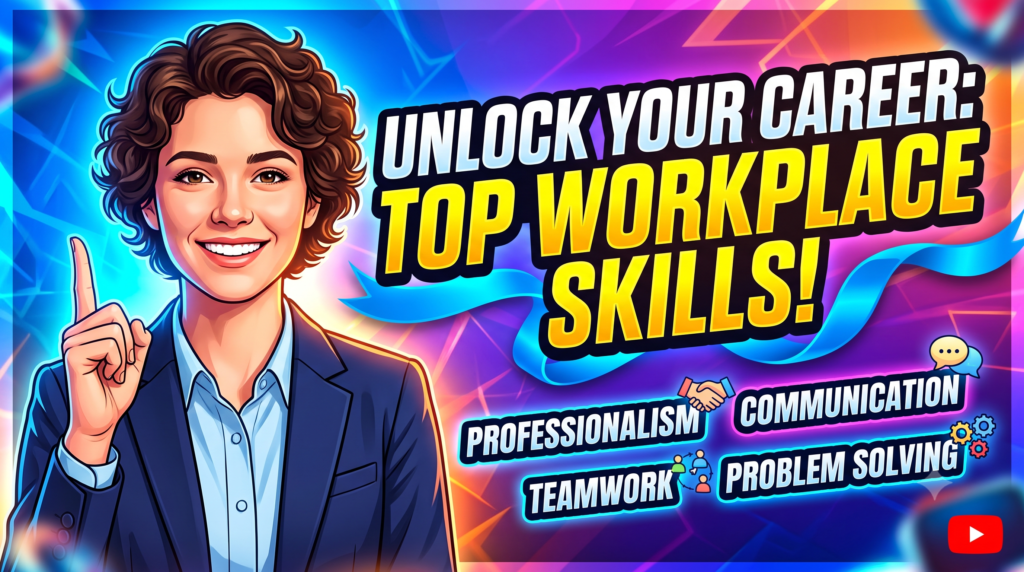
Workplace and professional skills (also known as employability or corporate competencies) are the combination of interpersonal abilities, work habits, and strategic thinking required to thrive in any organizational environment.
Core Categories of Workplace Skills
| Skill Category | Key Focus Areas | Practical Workplace Example |
| 1. Communication & Influence |
• Active listening
• Executive reporting & email etiquette
• Persuasion and negotiation
• Cross-functional alignment |
Drafting clear, jargon-free project status updates for non-technical stakeholders. |
| 2. Time & Workflow Management |
• Prioritization (Eisenhower Matrix)
• Deadline management
• Delegation and accountability
• Calendar and focus management |
Structuring daily high-impact tasks first and eliminating bottlenecks in recurring workflows. |
| 3. Critical Thinking & Problem Solving |
• Root-cause analysis (5 Whys)
• Data-informed decision making
• Strategic risk assessment
• Creative troubleshooting |
Identifying why a client deliverable failed and redesigning the process to avoid repeat errors. |
| 4. Emotional Intelligence (EQ) & Collaboration |
• Empathy and conflict de-escalation
• Cross-cultural competence
• Team synergy & giving/receiving feedback
• Self-regulation under stress |
Mediating disagreements between product and sales teams to align on a realistic delivery date. |
| 5. Adaptability & Digital Literacy |
• Agile execution
• Tool fluency (Slack, Asana, Notion, CRM)
• Prompting & leveraging AI productivity tools
• Fast upskilling / growth mindset |
Adopting new workflow software rapidly without letting standard team output decline. |
| 6. Professional Work Ethic & Ownership |
• Accountability and reliability
• Business ethics & integrity
• Professional boundary setting
• Punctuality and presence |
Owning project missteps proactively with an immediate mitigation plan. |
The Modern Professional vs. Outdated Habits
-
Proactive Problem Solving: Instead of surfacing issues to management with “We have a problem,” adopt the standard: “Here is an issue we encountered, and here are two proposed solutions.”
-
Asynchronous Communication: Writing comprehensive, standalone updates to reduce unnecessary meetings.
-
Continuous Feedback Integration: Treating performance reviews and team critique as objective data for skill iteration rather than personal criticism.
How to Showcase Workplace Skills on Resumes & Profiles
-
Use Action-Impact Framing: Don’t just list “Good team player.” Write: “Coordinated cross-functional alignment across 4 teams, reducing project turnaround time by 22%.”
-
Target High-Yield Keywords: Use industry-standard tags such as
Stakeholder Management,Conflict Resolution,Agile Execution,Workflow Optimization, andCross-Functional Collaboration.