
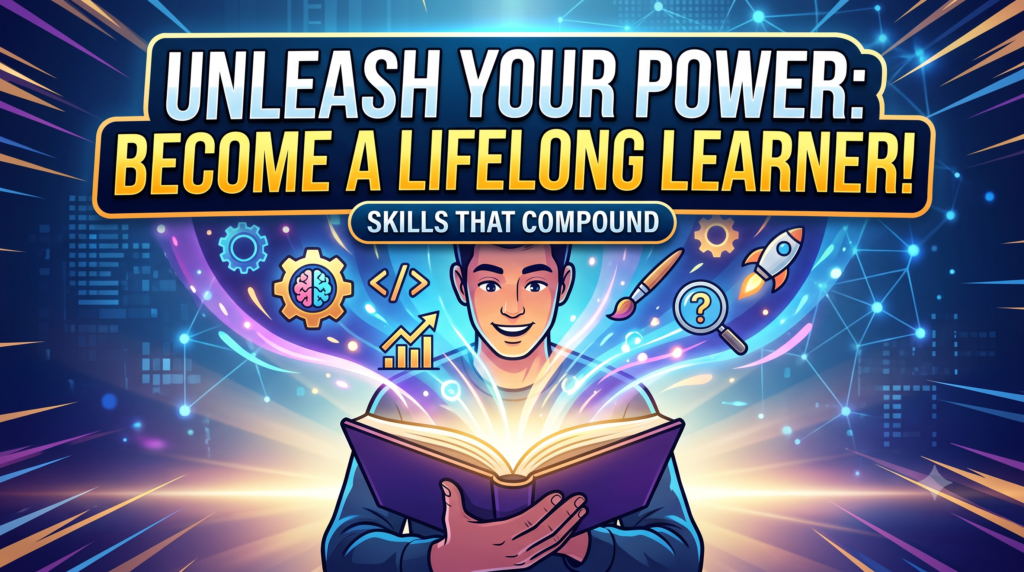
A Lifelong Learner is someone who engages in the ongoing, voluntary, and self-motivated pursuit of knowledge and skills throughout their entire life, far beyond the boundaries of formal schooling. It is an active mindset that treats learning as a continuous, everyday habit for personal fulfillment and professional adaptability.
Core Pillars of a Lifelong Learner
| Pillar | Focus | What It Looks Like in Practice |
| 1. Autodidacticism (Self-Directed Study) | Taking full ownership of learning | Choosing topics, finding resources, and studying independently without external pressure. |
| 2. Intellectual Curiosity | Asking “Why?” and “How?” | Exploring diverse subjects, questioning assumptions, and seeking deep understanding over superficial answers. |
| 3. Adaptability & Learnability | Unlearning and relearning | Quickly letting go of outdated practices to embrace new tools, workflows, and technologies. |
| 4. Applied Knowledge | Closing the theory-practice gap | Immediately applying new concepts through projects, writing, teaching, or daily problem-solving. |
| 5. Cognitive Plasticity & Openness | Psychological resilience | Viewing mistakes and constructive feedback as diagnostic data rather than personal failure. |
Key Daily Habits of Lifelong Learners
-
Curated Information Diet: Swapping passive doom-scrolling for high-signal articles, books, industry podcasts, and structured courses.
-
The “Feynman Technique”: Explaining complex ideas in simple, plain language to identify gaps in personal understanding.
-
Cross-Disciplinary Thinking: Connecting insights across different fields (e.g., applying psychology principles to software design or business strategy).
-
Consistent Micro-Learning: Dedicating 20–30 focused minutes every single day to skill acquisition rather than sporadic, exhausting study marathons.
Why It Matters in the Modern Era
-
Career Longevity: In an evolving, automated job market, technical skills depreciate quickly; the ability to learn new tools on demand is the ultimate competitive advantage.
-
Brain Health & Neuroplasticity: Continuously challenging the brain with new disciplines stimulates neural pathways and preserves cognitive sharpness over time.
-
Problem-Solving Versatility: Lifelong learners possess broader reference frameworks, allowing them to solve complex problems with innovative perspectives.
Pingback: AI course roadmap- vaishu – vaishnavikashyap.com